Change Language :

Cores wound in bundles and cores wound in layers
Stranding refers to the winding of cores in multi-core cable around a core element. Stranding plays a decisive role in the design of cable for movement. In principle, a distinction can be made between cores wound in bundles and cores wound in layers. Both versions are discussed in more detail below.
Differences between cores wound in bundles and cores wound in layers


Why is cores wound in bundles one of the best options?
Cores wound in layers is a method that is often used in industry to design cables. However, this traditional stranding method quickly reaches its limits when it comes to cables with many cores and constant movement.
In this video, we show you how cores wound in bundles ensures a significantly longer service life thanks to its optimised structure, especially in moving applications. Find out what advantages this stranding technology offers and how it helps to make cables more robust and reliable.
Examples of cable with cores wound in bundles


Examples of cable with cores wound in layers

Cores wound in bundles in use
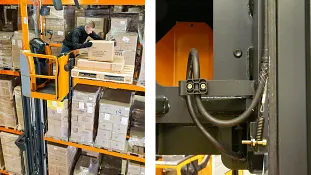
chainflex in Still's vertical order picker
The EK-X series from Still requires reliable cables for its mobile mast with guide rollers. Standard cables quickly failed in tests due to corkscrewing.
The solution: Flexible chainflex cables with cores wound in bundles. The strong design with strain relief offers long-term durability, even under high loads. The cables used here included a CF9 control cable.
Conclusion
Cores wound in bundles or cores wound in layers? When using a cable in an energy chain, cores wound in bundles is more suitable than cores wound in layers for cables with more than 12 cores. Due to the multiple stranding of the cores, all cores change the inner and outer radius of the bent cable several times at the same distance. Tensile and compression forces are thus equalised around the high-tensile core element, which gives the stranded structure the necessary internal stability.
This means that the stranding remains strong even under the highest bending loads. This results in a longer service life for the cable in energy chains.
Contact us
Contact details

Seán Ryan086 0329555Submit form
Opening hours
Office hours
Monday to Friday from 8 am - 8 pm.
Live chat:
24h