Change Language :
Energy chains for circular and spiral movements
Energy chains are the most modular way of safely transferring energy, data, fluids and air. Whether horizontally, vertically along all axes or in a circle. igus energy chains fulfil this requirement 100 per cent. Various systems for rotary and spiral movements can be selected, and properties such as modularity, versatility and a high degree of stability ensure dependability.
Alternatives to the slip ring:
As our energy chain systems are equipped without slip rings, media such as air, oil or water can easily be transferred without any interruption.
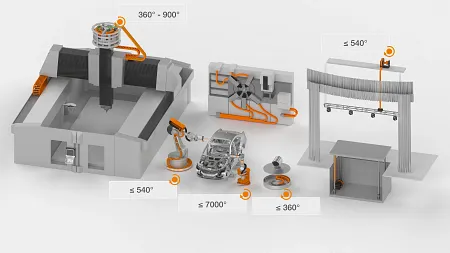
Rotary movements up to 900°


Rotations of 7,000° and more


The igus® system for fast rotary applications as a standard product
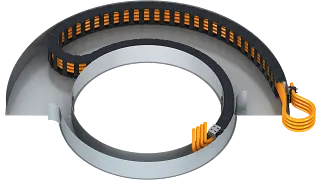
Fewer interfaces with static rotary modules
These rotary modules consist of a static guide trough. The fixed end of the e-chain® is attached to the guide trough and the moving end to the rotating part of the system. The e-chains® of the E4.1 series are used for the rotary modules. The static rotary modules are ideal for simple attachment in confined spaces.
Maximum rotation angle 400° (depending on the system)
Rotation speed up to 180°/s
Modular construction with standardised mounting options
Integrated strain relief and cable guidance in the guide trough
Typical application areas:
General machine and plant construction, production systems/material handling, industrial robots, medical technology, wind turbines, amusement rides, satellite telescopes
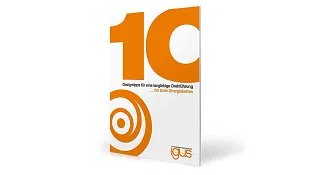
10 tips for a reliable rotating energy supply
Ten valuable tips for designing the right guide trough for circular modules yourself. Avoid mistakes that can reduce the service life of your system or even lead to failure.
From the contents:
- Planning guide plates correctly
- Tips for laying cables
- Limiting the maximum rotation angle
- Generating CAD data for troughs and entire modules
Download 10 tips now free of charge. We are also available to help and advise you personally at any time.
Hundreds of thousands of customers rely on energy chains for rotary movements from igus
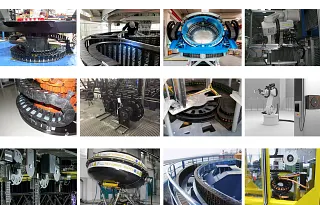
Energy chains for rotary movements from igus are used in various applications: The twisterchain is popular in the field of robotics. The twisterband is the perfect solution for rotary movements up to 7,200° in the tightest spaces. If more space is required for cables, we recommend using an RBR rotating energy supply system. e-spool is often used in theatre and stage technology applications.
► Application examples with twisterchain
► Application examples with RBR
► Application examples with e-spool
► Application examples with twisterband
Slip ring alternatives: Why rotary energy supply systems are the smarter choice
Traditional slip rings have long been used to transfer power through rotating applications, but they can be limited by wear, contamination, and restricted transmission capabilities. Modern rotary energy supply systems offer a more flexible alternative, enabling the safe and reliable transfer of power, data, air, water, hydraulics, and fibre optics within a single solution. Designed for durability, easy installation, and low maintenance, these systems help improve performance across a wide range of industrial applications.
Slip rings come with a lot of issues. For example, they are very susceptible to corrosion and being unreliable due the ingress of dirt. Above all, they are very limited in what they can transmit which is normally just power or basic data. You can’t use a slip ring for fluid, air, water or fibre optic cables. Rotary energy chain systems work well because you can put any service down them. You can have a mixture of air, water, power, servo, encoder and fibre optic cables together side by side. The energy chain itself guides the cables and hoses and keeps them secure within an enforced bend radius and with physical protection. These concepts are not possible for slip rings. Also, rotary energy supply systems not only offer a very universal system but can easily be upgraded later. This means that you can remove individual cables and replace them as and when you need to.
We supply the rotating energy supply as a complete system. This includes the energy chain complete with the cables and hoses pre-fitted inside them, with or without connectors as per the customer’s order. This also comes complete with the required guiding system. The guiding system is a critical because this keeps the chain operating smoothly and correctly whilst being fully protected. If you do not have a guiding system, the complete system will not work properly. We match it to the customer’s machine interfaces, and therefore installation is very simple and is a matter of just bolting on the whole system complete with the pre-fitted chain then plugging in the connectorised cables.
Rotating energy supplies can be used from the smallest to the largest machines across a range of industries. Currently we have them on tiny systems such as turnover tables, assembly jigs and medical scanning units, right through to giant systems for cranes that might be 30m across. We have also completed projects for TV studios where you have multiple television screens rotating around a presenter, and retrofitted systems into Victorian railway swing bridges to offer reliable hydraulic supply. There are so many variations and environments where they can be used.
The main technical benefits are that you can mix lots of different services in the same system, you can retrofit, add things and swap things out without having to upgrade the system. Also, they have a physical protection around them. Additionally, they are very quiet. The system is passive because it doesn’t need any power to move it, it just follows the system that the customer implements. It’s very simple, straightforward and universal.
They can be used in any application, it’s just a case of making sure the materials used in the guiding system are correct, for instance, using stainless steel for the maritime environments. Also, the environmental benefits of using energy chain systems is that there is no lubrication required so there are no repercussions of oil going into the environment. Also, there is no maintenance required, which is a good cost saving benefit for customers. The fact that our energy chain systems are plastic-based is an advantage because although single-use plastics get a bad rap, engineering plastics have a very long life and are actually far less environmentally intensive than their metal alternatives.
The rule is that the cable must be a good dynamic cable to work well in one of these. igus® chainflex® cables are our niche product range; we make cables that are guaranteed for 4 years or 10 million movements, therefore we would ideally like to specify cables that we know can perform well. We can then guarantee the whole system. However, if the cable is a proper cable it will work, if it’s not it simply will not last in an environment like this because of the continuous twisting motion.
The minimum bend radius of the cable is defined by the cable manufacturer. We have all that data for our chainflex® cables, and we design around that. If there is another cable or hose that must go in, the manufacturer has to define what that is. This must be a dynamic minimum, which is for long life and not just a static minimum.
Go to igus.co.uk and follow the links for the online tools. There is also a simple 3D CAD configurator, where you can put in some data and get some indications of packager space requirements for the whole system. We would however recommend discussing your requirements with us early in the project, because when we begin integrating the whole system into the premade “cartridge” it needs to interface correctly with your system. Talk to us early and we can help you get basic dimensions from the configurator, right through to the detailed system design and planning.
With very large heavy-duty systems, where the rotation angle is over 360 degrees, or if the system is running in a non-horizontal orientation, for example on a large diameter system up to 30m across, then we have various design features that we can implement such as floating islands, ramps and/or guiding plates to ensure that the energy chain performs correctly during operation’. This might be vital on systems used on vessels because the vessel might be pitching and rolling in the waves. We have lots of different tools available to us such as, floating islands, tubular guide systems, cable strain relief etc. that allow us to completely fulfil the customers’ requirements.
For our standard energy chains, very high temperatures can be an issue. For example, ambient temperatures over 120° or -40°, or exposure to extremely strong acids however, those types of applications are rare. That said, we do have a range of materials (temperature/chemical resistance, electrically conductive etc.) available to us so we can mould the energy chain parts with these if required.
It’s great if we can get involved early in the project, so we can help get basic dimensions from the online configurator tools, right through to the detailed system design and planning. Installation should be straightforward if you have a whole design drawn up and delivered in a single piece. In fact, we offer a range of onsite services, they range from commissioning just the system once it’s completed or, supervision to help the customer install themselves or we can offer full turn-key installation. We can work with whatever suits the customer’s resources in terms of their available staff, their experience and their budget.
For a fully customised rotary energy chain system, it should take a matter of weeks to manufacture after we get the design signed off by the customer; we can minimize that according to their deadline. However, the type of projects that require these systems usually have a long lead time so there is normally plenty of time to prepare. The key thing is to talk to us early and we will work to meet your deadline.
More information on energy chains


Contact us
Contact details

Seán Ryan086 0329555Submit form
Opening hours
Office hours
Monday to Friday from 8 am - 8 pm.
Live chat:
24h