Change Language :
Independent 3D printed wear tests
igus 3D printing materials last up to 300x longer than ABS
Data drives everything and when it comes to reliability and performance, these tend to be driven by data, test results and proof.
As data is the key, we thoroughly test all of our products in order to provide comparison information, service life and longevity. We have a 3,800m² test laboratory which provides real test data for all products, including our 3d printing materials. With these tests, we have proved that our 3d printing materials offer 300x longer service life than that of parts manufactured from ABS and with our free online configurators, you can see the data for yourself when it comes to your application.
Wear tests data on this page:


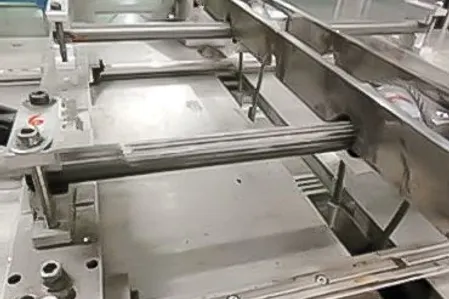
Wear test: Linear long stroke
Test parameters:
- Surface pressure: 0.11MPa
- Surface speed: 0.34m/s
- Stroke: 370mm
- Running time: 3 weeks
Shaft materials: aluminium hc
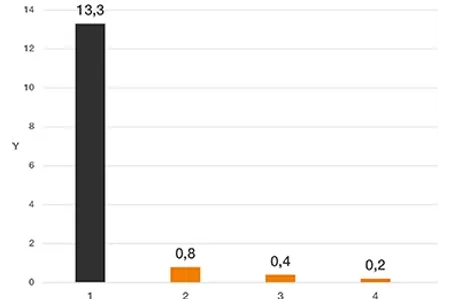
Y-axis: Wear rate [μm/km]
X-axis: Materials in the test
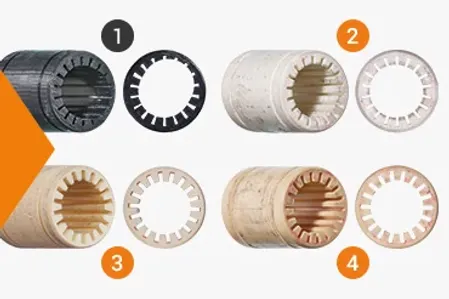
1. ABS (FDM 3D printing)
2. iglidur i180 (FDM 3D printing)
3. iglidur i3 (SLS 3D printing)
4. iglidur J (injection moulding)
Test result:
- 15 times lower wear values for iglidur i180 (FDM)
- 33 times lower values for iglidur i3 (SLS).
- iIeal for long-stroke applications, e.g. XY linear robots for pick & place applications or plain bearings and glide bars in the 3D printer.
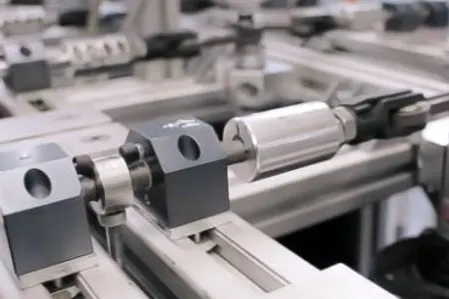
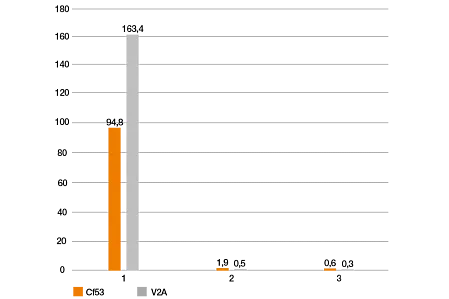
Wear test: Linear short stroke
Test parameters:
- Surface pressure: 1MPa
- Surface speed: 0.3m/s
- Stroke: 5mm
- Running time: 1 week
Shaft materials:
■ CF53 / AISI 1055: Hardened steel
■ 304 SS / AISI 304: Stainless steel
Y-axis: Wear rate [μm/km]
X-axis: Materials in the test
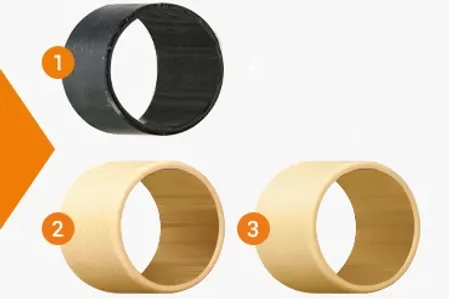
1. ABS (FDM 3D printing)
2. iglidur J260 (FDM 3D printing)
3. iglidur J260 (injection moulding)
Test result:
- J260 has similarly good wear rates, regardless of whether it was manufactured in 3D printing or injection moulding.
- iglidur J260 injection moulded plain bearings and 3D-printed bearings were tested with the same load and surface speed.
- Coefficients of friction and abrasive wear of our iglidur 3D printing materials are many times lower than those of standard ABS materials
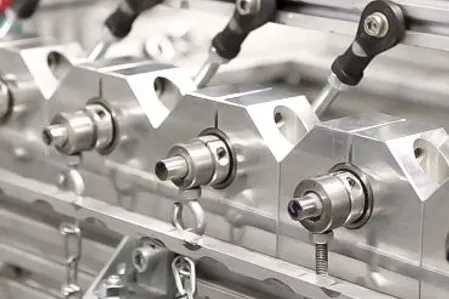
Wear test: Pivoting
Test parameters:
- Surface pressure: 20MPa
- Surface speed: 0.01m/s
- Pivoting angle: 60°
- Running time: 4 weeks
Shaft materials: 304 SS
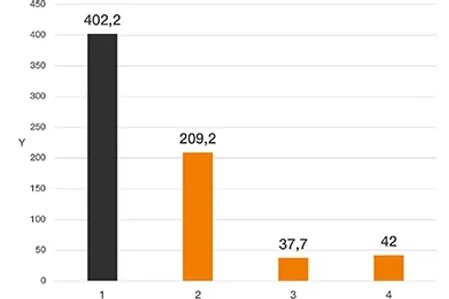
Y-axis: Wear rate [µm/km]
X-axis: Materials in the test
1. PA12 (SLS 3D printing)
2. PA12 + glass beads (SLS 3D printing)
3. iglidur i3 (SLS 3D printing)
4. iglidur W300 (injection moulding)
Test result:
- In the pivot test, the tribological specifications of the iglidur materials lead to up to 50 times higher abrasion resistance compared to the standard 3D printing materials (e.g. PA12).
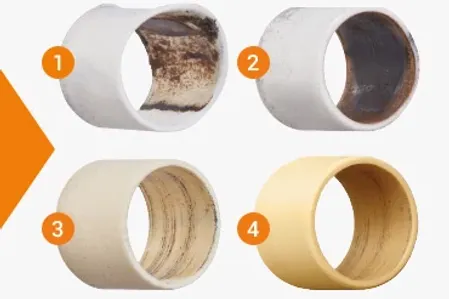
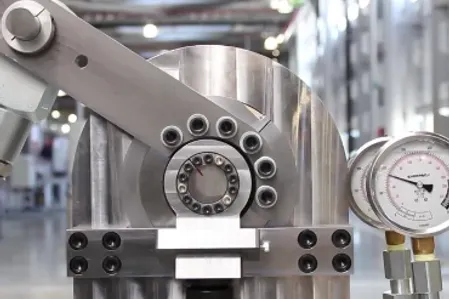
Wear test: Pivoting heavy load
Test parameters:
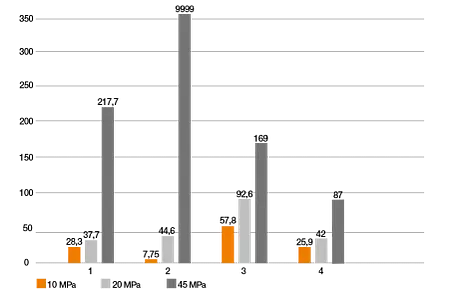
- Surface pressure: 10, 20 and 45MPa
- Surface speed: 0.01m/s
- Pivoting angle: 60°
- Running time: 1 week
In the test, plain bearings with a diameter and length of 20mm were tested, i.e. a load of 1,800kg was applied to the 3D-printed plain bearing.
Y-axis: Wear rate [µm/km]
X-axis: Materials in the test
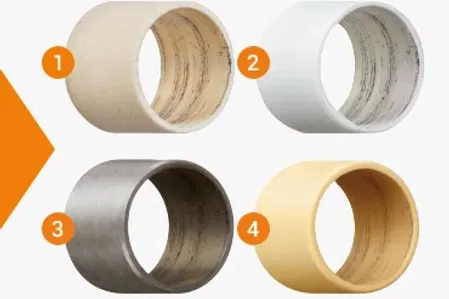
1. iglidur i3 (SLS 3D printing)
2. iglidur i180 (FDM 3D printing)
3. iglidur G (injection moulding)
4. iglidur W300 (injection moulding)
Test result:
- 3D-printed plain bearings (SLS process) can be subjected to a surface pressure of up to 45MPa.
- The abrasive wear is just as good as with plain bearings from injection moulding. Use in high-load applications is therefore possible.
Wear test: Drive nut
Test parameters:
- Torque: 129Nm
- Stroke: 370mm
- Speed (spindle speed): 290rpm
- Running time: 2 weeks
Y = Wear rate [µm/km]
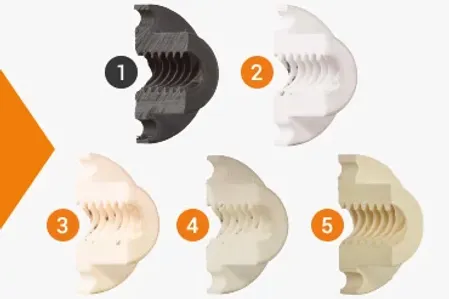
X-axis: Materials in the test
1. ABS (FDM 3D printing)
2. iglidur i180 (FDM 3D printing)
3. iglidur J260 (FDM 3D printing)
4. iglidur i3 (SLS 3D printing)
5. iglidur J (injection moulding)
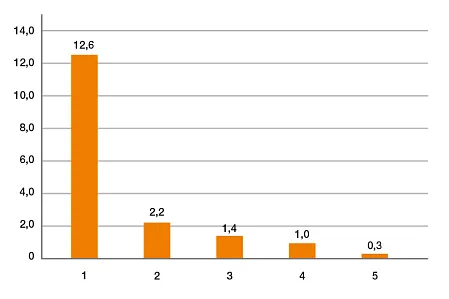
Test result:
- The wear resistance of igus 3D printing materials compared to conventional materials, depending on the 3D printing material and process, is 6 to 18 times
higher. - Producing drive nuts using 3D printing offers cost advantages
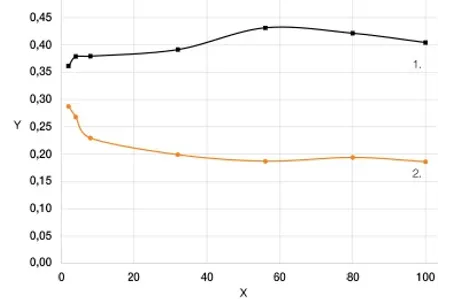
Friction coefficient test: Rotating
Wear-resistant plastic iglidur and standard ABS material in comparison - lower coefficient of friction with iglidur
Wear-resistant plastics and tribological specifications are helpful in the design of motors or drive forces, since with half the friction only half the drive force is required. With our free Long Life Calculator for plain bearings, you can determine how long a 3D-printed plain bearing made of iglidur will last in your application by specifying your requirements.
Test parameters:
- Surface pressure: 1MPa
- Surface speed: 0.1m/s
Shaft material: Cf53
Y = Coefficient of friction [-]
X = Running time [h]
1. PA12 (SLS 3D printing)
2. iglidur i3 (SLS 3D printing)
Test result:
- The tribological specifications of iglidur i3 are better in the test by a factor of 2 than with the standard 3D printing materials.
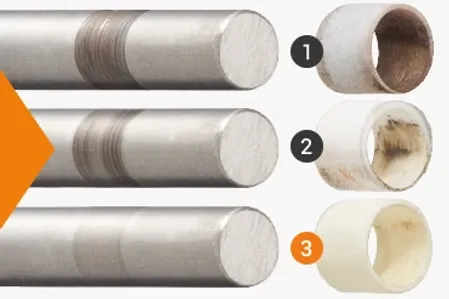
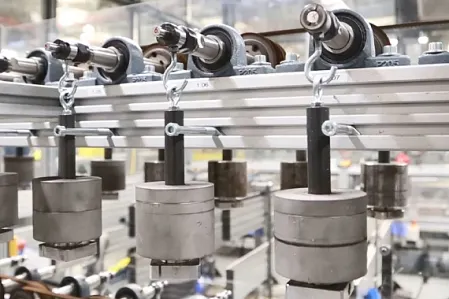
Wear test: Rotating
Wear values of iglidur 3D printing materials in comparison with common 3D printing plastics
Test parameters:
- Surface pressure: 20 MPa
- Surface speed: 0.01 m/s
Shaft material: 304 SS
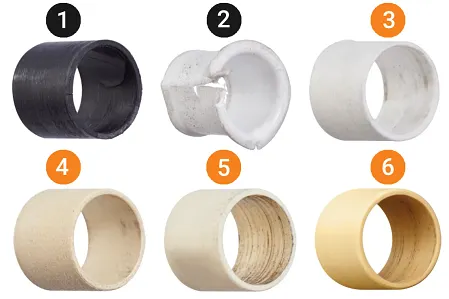
Y-axis: Wear rate [µm/km]
X-axis: Materials in the test
1. ABS (FDM 3D printing)
2. PA12 (SLS 3D printing)
3. iglidur i180 (FDM 3D printing)
4. iglidur J260 (FDM 3D printing)
5. iglidur i3 (SLS 3D printing)
6. iglidur W300 (injection moulding)

Test result:
- The wear of printed plain bearings made from iglidur i180 is 89.5% lower than that of bearings made from the ABS plastic.
- The sintered bearing made of iglidur i3 proved to have 94.87% less wear than the sintered bearing made of PA12.
- Only the bearing made of the special filament iglidur J260 and the bearing manufactured in injection moulding from iglidur W300 exhibited better values.
Wear test: Rotating under water
Test parameters:
- Surface pressure: 1 and 2MPa
- Surface speed: 0.3m/s
- Temperature: 23°C
Shaft material: 304SS
X-axis: Materials in the test
1. iglidur i3 (SLS 3D printing)
2. iglidur i8-ESD (SLS 3D printing)
3. iglidur J (injection moulding)
4. iglidur UW (injection moulding)
5. iglidur UW160 (injection moulding)
Y-axis: Wear rate [µm/km]
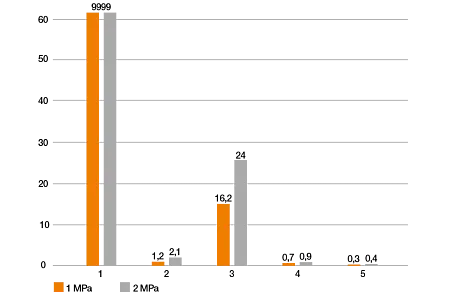
Test result:
The rotation test under water shows that 3D-printed plain bearings made of the [electrostatically dissipative SLS material iglidur i8-ESD] have a particularly high service life and the material is therefore just as suitable for such applications as the injection moulding materials iglidur UW and UW160, which were specially developed for use under water.
iglidur J is a frequently used igus material in a dry environment, but is not so well suited for use under water due to its rather high wear rate.
Test for UV and weather resistance
Comparison of the change in strength of iglidur materials for 3D printing and injection moulding
Test conditions:
- ASTM G154 cycle: Simulation of weathering and UV light
- Duration: 2,000 hours
X-axis: Materials in the test
1. iglidur i8-ESD (SLS 3D printing)
2. iglidur i3 (SLS 3D printing)
3. iglidur i6 (SLS 3D printing)
4. iglidur J (injection moulding)
5. iglidur G (injection moulding)
Y-axis: percentage change in strength
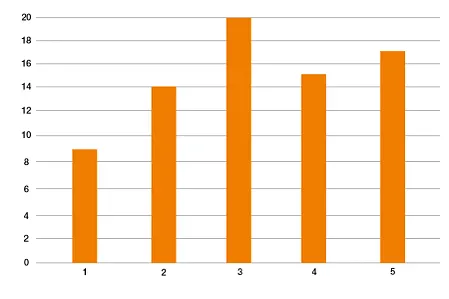
Test result: SLS materials are in no way inferior to injection moulding materials
After the bending test specimens were exposed to moisture and UV light for 2,000 hours in the test, it was shown that the iglidur materials for selective laser sintering exhibit a similar change in strength as the most frequently used injection moulding materials iglidur J and G. The SLS material iglidur i8-ESD is the most resistant to weathering and UV light. This test makes it clear that the iglidur 3D printing materials are in no way inferior to the injection moulding materials in terms of UV and weather resistance.
3D printing polymers that, in moving parts, last up to 80 times as long as normal plastics
The statistics provided on this page are through testing in our test laboratory and confirmation and proof by our customers.
Calculated, tested, proven: each statement about the service life of iglidur plastics for additive manufacturing is based on comparisons that have been performed many times.
Their evaluation is also the data basis for our Life time Calculator - which you can use to calculate the expected service life of your printed components in just a few clicks.
Contact us
Contact details

Seán Ryan086 0329555Submit form
Opening hours
Office hours
Monday to Friday from 8 am - 8 pm.
Live chat:
24h