Change Language :
Do ball bearings need to be greased?
Grease, oil, lubrication and ball bearings together is something that gets discussed a lot. Do ball bearings need to be greased? It depends. This page gives you an insight as to why some ball bearings do need to be lubricated and some don't.
| Attribute | Plastic ball bearing | Metal ball bearing |
|---|---|---|
| Needs greasing/ lubricating | No | Normally yes |
| Chemical resistant | Yes, some highly | Yes, but limited |
| Requires maintenance | Minimal if required at all | Regularly |
| Corrosion resistant | High | Moderate |
| Weight | Low | High |
Different ball bearing materials
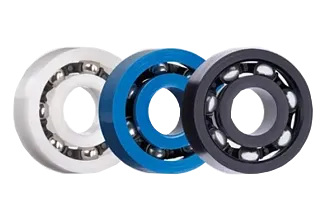
Plastic ball bearings
The lubrication-free ball bearings made of plastic, for example work without it. Unlike with metal, the high speeds of over 5,000rpm cannot be realised, but only a few applications rotate at such high speeds. Most applications usually run with low load and speed. Ball bearings made of plastic are always impressive when used in liquid media such as water or chemicals.
But plastic ball bearings can also be a better alternative in applications with elevated temperatures of up to 150°C. In addition, such bearings offer considerable advantages over metal in terms of ease of movement. As they do not have to overcome the resistance of the lubricant, they run with a much lower breakaway torque. They are also very light and can be supplied with glass balls on request, making them completely metal-free and non-magnetic.
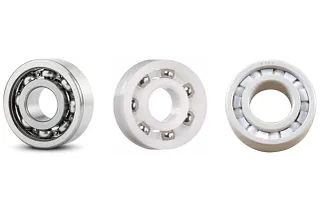
Ceramic ball bearings
Another lubrication-free alternative are ball bearings made of technical ceramics. Ceramic materials are generally very resistant to wear, corrosion and temperature. They are also lightweight, rigid and electrically insulating - all specifications that are very favourable for applications with rolling bearings. Despite the significantly higher costs compared to metallic materials, technical ceramics such as silicon nitride, silicon carbide and aluminium oxide have long been established as ball bearing materials. In many cases, however, they have so far only been used in applications where the advantages of ceramics really come into play and buyers are not put off by the higher procurement costs, precisely for cost reasons.*
In contrast to the alternatives mentioned, metallic ball bearings must be lubricated. Without lubrication, these bearings would otherwise rust very quickly and deform during use due to the high frictional forces and lack of cooling, which in the worst case could lead to blockage of the bearing. Lubrication is essential for sealed ball bearings in particular, as otherwise the plastic or rubber seals will become porous. This can cause grease to escape and result in the bearing running dry. Although stainless steel ball bearings do not corrode, they are significantly more expensive to purchase than plastic ball bearings.
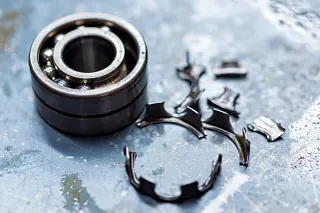
Metal ball bearings
Metal ball bearings are commonly used in applications such as; industrial machinery, automotive and other rotating equipment. They offer extreme high load capacity, durability, and precision. Metal bearings tend to be manufactured from hardened steel or stainless steel and are widely used to prevent friction between moving parts.
In order to achieve optimal performance and service life, quite a few metal ball bearings require lubrication, either grease or oil, which helps minimize wear and dissipate heat. They also can help protect against corrosion.
Metal bearings are renowned for exceling in high-speed and high-load applications, however their performance can be severely affected by outside environmental issues such as; contamination, moisture, and inadequate lubrication. The downside to this is that they can require regular maintenance and downtime.
Frequently asked questions
Depending on the material type depends if the ball bearings need to be lubricated. A lot of plastic ones do not require lubrication making them a great alternative to metal ones
If you have to lubricate the ball bearing, the best lubrication will depend on the application/ environment. There will be different lubrications for high speed, corrosive environments so it will depend. For a general all purpose application, a lithium based grease is suggested.
If the ball bearing requires lubrication, so a metal variant, then a lack of grease or oil can increase the risk of failure, increased wear and friction.
It depends on the application but most plastic ball bearings can withstand a lot so when choosing which is best, metal or plastic, it depends on your requirements.
Certain applications and industries really need lubrication free ball bearings. Industries such as; Food and Packaging, Chemical environment, cleanroom
Contact us
Contact details

Seán Ryan086 0329555Submit form
Opening hours
Office hours
Monday to Friday from 8 am - 8 pm.
Live chat:
24h