Change Language :
Lead screw wiki
On this page you will find important technical information that is commonly discussed regarding lead screws and lead screw nuts in the form of frequently asked questions. You will also find technical data such as tolerance information and material specifications and links to more information.
General frequently asked questions
The dryspin® high helix thread range covers diameters from 4 to 20mm and pitches from 2.4 to 100mm. Thanks to the diversity of the product range, dryspin thread geometry can be used in almost any application.
To the product rangeBasically, yes. The application parameters (axial load, speed, etc.) must be observed and the required positioning accuracy must be achieved. Our lead screw drive expert offers optimal assistance in selecting the ideal thread system for every application.
Find out more information- Higher efficiency
- Low-noise and low-vibration operation
- 30% longer service life due to asymmetry
- Up to 25% less wear
- Greater efficiency
Our drylin lead screw nuts are up to 50.9% more cost-effective than metal lead screw nuts. They are also up to 69% more cost-effective than comparable plastic lead screw nuts and up to 50% more cost-effective than ball screw systems.
Self-locking means that movement of the lead screw and lead screw nut is not possible without external force. This is related to the pitch and coefficient of friction.
Read all about self-locking lead screwsLead screw nuts made from tribologically optimised iglidur materials are suitable for use in temperature ranges between -20°C and +150°C.
Our lead screw support blocks are available for thread sizes 6 – 24mm. They are available with plain bearings or, for higher dynamics, with ball bearings (BB). All lead screw support blocks are supplied in anodised aluminium, as are the matching lead screw clamping rings.
In addition to selecting the right material for the lead screw nut, a pretension mechanism has proven to be an effective measure against unwanted bearing clearance in practice. For trapezoidal threads and dryspin high helix threads, anti-backlash, zero-backlash and low-clearance variants with pretension for the lead screw nut are available.
It is no secret that igus stands for non-lubrication of bearings. Simply put, igus products do not require lubrication. We often hear the same question from customers: "Can I use WD-40 or another lubricant to lubricate my bearing?" but it is not recommended.
Our dryspin thread geometry is an excellent alternative to conventional trapezoidal threads. Wear tests show that the thread dimensions with dryspin geometry have a wear rate that is up to 25% lower and a service life that is up to 30% longer.
The load capacity of trapezoidal lead screw nuts made of high-performance polymers depends on the surface pressure, the surface speed and the resulting temperature. The temperature behaviour is also influenced by the duty cycle and the selected lead screw material and its specific thermal conductivity.
Frequently asked questions on lead screws and nuts


At igus, we distinguish between two manufacturing processes: thread rolling and thread whirling. Both processes have their own special specifications. igus uses thread rolling as its standard process due to the cost savings, better surface finish and longer service life it offers. Thread whirling is more suitable for small quantities and very precise threads with tight tolerances.
From concept to the finished lead screw in just five minutes. With the configurator, you can quickly find the right lead screw and customise the machined ends from both sides. The application generates a dimensional drawing of your configuration for you immediately.
Configure your leadscrewSingle-start lead screws consist of only one thread (single start). This means that the distance between the flanks, which is characterised by the pitch, is also the linear travel in millimetres per revolution of the lead screw.
If another thread is added, the lead screw achieves twice the stroke with one revolution. The calculation for the linear travel remains the same depending on the number of threads; only the pitch of a single thread differs. This procedure can also be applied to our multi-start dryspin® high helix lead screws.
Read more about the differencesOur new dimensions are suitable for a 1:1 replacement: DS10x3, DS14x4, DS18x4, DS10x2 and DS12x3. You can find more information about your replacement here. If you have any questions, our experts will be happy to help.
When assembling a cylindrical lead screw nut made of plastic, axial and radial securing is necessary. One option for radial securing is the use of set screws. The locating spigot can be achieved with a sheet metal ring.
When fastening a plastic flange lead screw nut, it is particularly important not to exceed the maximum tightening torque of 2.5Nm. It is also recommended to secure the fastening screws using a third medium, e.g. liquid thread-locking glue.
In addition to the correct choice of material, a preloading mechanism has proven to be an effective measure to reduce unwanted axial clearance. For our dryspin® high helix threads and trapezoidal threads there are three options with pretension: zero-backlash, low-clearance and AB lead screw nut. Here you will find all the advantages and assembly instructions for our clearance-reduced lead screw nuts.
Find out about low clearanceThe special type of the JGRM lead screw nut, in combination with a stainless steel plate, enables it to withstand static loads of up to 6MPa.
How to reduce unwanted clearance

Why is test data so important?
Test results are one of the most important aspects of our company. Without test data, nothing is proven, nothing is validated so we cannot offer:
✅ Real service life calculations
✅ Wear results
✅ Material behaviour
✅ Comparison results
✅ Efficiency
✅ Coefficient of friction
Test data represents proof, proof of operational performance and compliance and we test thoroughly for every product that we have in order to give the most accurate information in our data sheets, our online tools and configurators and ensure our solutions are reliable for our customers.
Frequently asked questions about tolerances
Apart from the pitch accuracy of 0.1 on 300mm, customer-specific tolerances are implemented for the end machining of lead screws and nut machining.
According to DIN 103, tolerance class 7e
What are self-locking lead screws?
In order to be able to answer the question about what a self locking lead screw is, we need to fully understand what is meant by the term "self-locking"
In engineering terms, the term "self-locking" refers to a mechanical drive that remains stationary even when an external force is applied.
To understand how this term is reflected in lead screw technology you can read all about it in the blog.

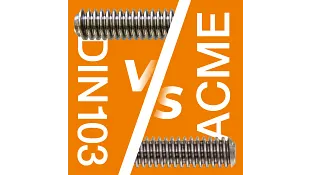
Difference between ACME and trapezoidal thread
This is a common question for us as a supplies of leadscrews, especially when we supply both trapezoidal and acme. The simplest explanation is geography! The USA and EU have different ways of manufacturing threads,
- The European trapezoidal thread (according to DIN 103)
- The American ACME thread (according to ANSI B1.5 2C)
There may only be small differences in the manufacturing process but these have a major impact.
Calculation formula
The surface pressure of the materials
| Material | MPa |
|---|---|
| iglidur® J | 4 MPa |
| iglidur® W300 | 5MPa |
| iglidur® A180 | 3.5 MPa |
| iglidur® J350 | 2 MPa |
| iglidur® E7 | 0.5 MPa |
| iglidur® J200 | 2 MPa |
| iglidur® R | 2 MPa |
Surface speeds of the iglidur® materials in m/s:
| iglidur® material | rotating long-term |
|---|---|
| iglidur® J | 1.5 |
| iglidur® W300 | 1.0 |
| iglidur® A180 | 0.8 |
| iglidur® J350 | 1.3 |
Max. permissible pv value
Using the pv value and the effective support surfaces specified in the dimension tables, the permissible surface speed and the resulting feed rate can be determined for each thread size.
Standard values when using drylin® plastic nuts without lubrication (with a stroke of 500mm). A correction factor must be taken into account for very short or long strokes.
| Duty cycle ED | pv valuemax.[MPaxm/s] |
|---|---|
| 100% | 0.08 |
| 50% | 0.2 |
| 10% | 0.4 |
Formulary
| Designation | Meaning |
|---|---|
| Faxial | Axial force |
| Pperm. | Max. permissible surface pressure 5N/mm2 |
| Preal | actually occurring surface pressure for the selected size |
| Ae real | Effective support surface of the selected trapezoidal lead screw nut |
| P | Pitch |
| d1 | Pitch diameter |
| Mta | Drive torque [Nm] when converting a rotary into a longitudinal movement |
| Mte | Drive torque [Nm] when converting a longitudinal movement into a rotary movement |
| v | Surface speed [m/s] |
| s | Feed rate [m/s] |
| n | Rotational speed [min-1 |
| η | Efficiency |
Contact us
Contact details

Seán Ryan086 0329555Submit form
Opening hours
Office hours
Monday to Friday from 8 am - 8 pm.
Live chat:
24h