Change Language :
Plain bearing wiki
On this page we have summarised all the important technical issues relating to our plain bearings, which hopefully will help designers when designing applications. Find out more about our plain bearing materials and their specification. There are also important tips for the use of iglidur® plain bearings and expertise from practice and research which we make available to you free of charge in our whitepapers.
What you will find on this page
What is iglidur®?
iglidur® are materials developed by igus. They consist of high-performance polymers and are characterised by special specifications. For example, they are particularly wear-resistant or suitable for contact with media and chemicals.
But what are iglidur materials made of? And what is behind the self-lubricating effect? Find out more about the specification and composition of iglidur bearings.

Comparison of different bearing types
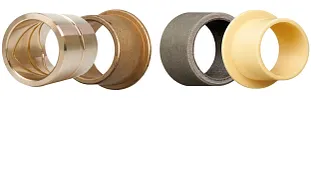
There are various bearing types to choose from when selecting the right plain bearing. Each has a different design and its own mode of operation. We have summarised the most important bearing types for you and show you what advantages they have.
Choosing the right shaft material
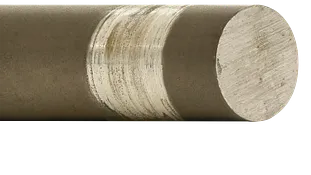
The right choice of shaft and plain bearing plays a decisive role in a well-functioning bearing system. Plain bearings protect the often significantly more expensive drive shaft and the components surrounding the bearing point from wear. It is therefore particularly important that this wear only occurs in the plain bearing and that it is replaced in good time. However, the shaft is often neglected when designing the bearing position. Find out how to correctly match the two components to each other.
Installation and tolerances
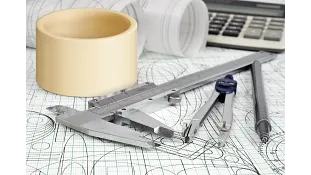
When installing plain bearings, there are a few things to bear in mind that are crucial for fault-free operation and a long service life. Find out everything you need to know about suitable installation and testing methods, clearance design, standard tolerances and the correct securing of plain bearings. All of these elements will help prolong the life of your bearing.
What are hydrodynamic and hydrostatic plain bearings?
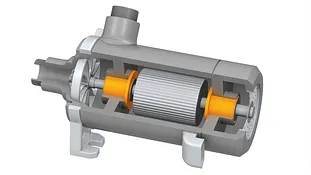
What are hydrodynamic and hydrostatic plain bearings? How do these two bearing types work, what are their advantages and what are their typical areas of application? Answers to these questions can be found here.
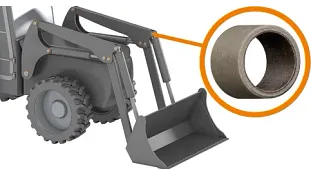
Plain bearings in heavy-duty applications
Unsure if a plastic plain bearing is up to the task of a metal one? This page will not only give you test results comparing various plain bearing materials but will prove that plastic plain bearings can withstand high loads, harsh environments and can be used as a metal equivalent.
Correctly securing plain bearings
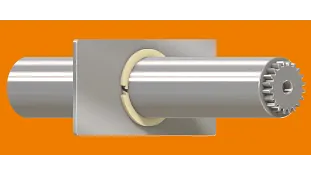
Plain bearings are crucial components in structures where there are moving elements. Even the smallest of errors when securing bearings can have serious consequences; such as noise, excessive wear or complete failure. Find out what the most common causes of these problems are, and we will provide you with suggested solutions and show you how to optimally secure plain bearings.
What does the pv value mean?
PV value
The product of the specific load [p] and the surface speed [v] is of particular importance for plain bearings. The pv value can be regarded as a measure of frictional heat and therefore be used as an analytical tool to check a plain bearing's suitability. For this purpose, the actual pv value is compared with a predictable permitted pv value. The permitted pv value depends on the shaft material, the ambient temperature and the duty cycle.


General bearing frequently asked questions
Plain bearings decouple moving parts from each other to protect their surfaces from wear and to reduce the friction between them. Due to the lower coefficient of friction, the force required for the movement and therefore the energy can be reduced.
Plain bearings are used wherever friction and wear on surfaces that are subject to movement need to be reduced. The fields of application range from the mounting of bridges that expand under the influence of temperature, to the moving elements of an office chair, to the pinhead-sized plain bearing in electric toothbrushes.
In general, plain bearings are particularly suitable for applications in which the combination of load or surface pressure and intensity of movement is not too high. This is referred to as the pv value, which is the product of surface pressure in N/mm² and speed in m/s. The maximum permissible pv value is specified by the manufacturer for most plain bearings. If this is exceeded due to the application conditions, the plain bearing is unsuitable for these conditions. In this case, either additional cooling or the use of a ball bearing must be considered. However, with sufficient cooling or reduction of friction through lubrication, plain bearings can also be used with very high PV values.
In mechanical engineering, the term plain bearing refers to components that decouple surfaces that move relative to each other. This protects these surfaces from wear-related damage and reduces the coefficient of friction and thus the energy required for movement, as well as heat generation.
The EC guideline 2002/95/EC ("RoHS 1") behind the keyword "RoHS" was replaced on 3 January 2013 by EC guideline 2011/65/RU ("RoHS 2").
The guideline regulates the restriction of undesirable substances in electrical and electronic equipment placed on the market in the EU. The abbreviation RoHS stands for "Restriction of (the use of certain) Hazardous Substances".
As it is not technically feasible to completely dispense with many materials and products, specific limit values have been defined.
The substances concerned are lead, mercury, cadmium, hexavalent chromium, polybrominated biphenyls (PBB) and diphenyl ether (PBDE), which are frequently used in electronics. Examples of applications include the use of lead in soldering or as a component of metallic composite bearings and the use of PBBs as flame retardants. These substances are also found in numerous metallic alloys.
As can be seen from a glance at the substances and these application examples, these substances do not play a role in thermoplastic compounds such as our iglidur® materials. The ingredients of our iglidur® materials therefore fulfil the requirements of guideline 2011/65/EU (RoHS 2). We will be happy to send you explicit confirmation of this upon request.
The stick-slip effect refers to the jerky sliding of solid bodies moving against each other. This phenomenon occurs when a body is moved whose static friction is significantly greater than the sliding friction.
Imagine a heavy cardboard box that you want to push across a smooth floor. The box is heavy, which is why we have to exert a lot of force to overcome the static friction - i.e. the resistance of the box to move. The cardboard slides. Due to the smooth surface and the resulting low sliding friction, the carton quickly speeds up. However, the rapid sliding movement of the cardboard means that we can transfer less force to the cardboard. Eventually, the force acting on the carton is no longer sufficient to overcome its static friction. The carton comes to a standstill, which means we have to apply a lot of force again to overcome it and the process repeats itself. Sticking - releasing - sliding - braking - sticking - releasing... in reality, this effect happens much faster and manifests itself in a stutter. .
This phenomenon occurs in a wide variety of areas. Windscreen wipers stutter across the windscreen of a car. Chalk squeaks when you write on a sheet of paper if you hold it at the wrong angle. Door hinges squeak. And stringed instruments such as the violin or cello would not work, because their sounds are caused by vibrations and oscillations between the strings and the tendons of the sag.
With tribologically optimised materials, however, this effect is undesirable. The vibrations caused are transferred to the overall construction and cause noises that are often perceived as annoying squeaking or creaking. The desired sliding movement becomes an irregular stuttering and increases wear on the bearing. These effects can be counteracted by minimising the difference between sliding and static friction, using vibration-damping materials, improving the rigidity of the overall structure (see preloaded bearing) or separating the friction partners involved (e.g. by lubrication)
1: Wear test with oscillating movement of a iglidur®plastic plain bearing from igus®.
Influencing factors:
Shaft selection: Different shaft materials are recommended for different plain bearings. Each shaft-bearing combination has different wear results.
load: As radial loads or surface pressures increase, the wear on the plain bearings also increases. Some plain bearings are designed for low loads, others for high loads.
Speed and type of movement: As the speed increases, so does the wear. The type of movement (oscillating, rotating or linear) also has a significant influence on the wear rate.
Temperature: Within certain limits, temperature has little effect on the wear of a bearing, but it can also accelerate wear exponentially. Plastic bearings are suitable for a wide temperature range, depending on the material selected. However, wear can increase significantly if the maximum application temperature is exceeded. With most iglidur® materials, the wear rate increases with rising temperatures. However, there are also exceptions that only reach their minimum wear at higher temperatures.
Dirty environment: Dirt and dust can accumulate between the shaft and bearing. This causes wear. Self-lubricating plastic bushings offer an advantage here: because they do not contain any oil, dirt and dust cannot stick to the shaft and damage the bearing.
Contact with chemicals: Plastic plain bearings are completely corrosion-free and resistant to a wide range of chemicals, but certain chemicals can even change the structural specification of a plain bearing, reducing the hardness of the bearing and increasing wear.
2: Wear tests with different shaft types.
The following applies to all these points: the more precisely I know my application and the parameters addressed, the more specifically a iglidur® material selection and a service life extrapolation can be made. Selecting the right material is crucial for service life.
Over the years, the material developers at igus® have developed hundreds of material compounds, almost 40 of which have now found their way into the polymer plain bearing catalogue. The basic structure is usually the same:
1. base polymers, which predetermine the basic tribological, mechanical, thermal and chemical specifications of the bearing
2. fibres and fillers, which give the bearings a high mechanical load capacity
3. solid lubricants that significantly optimise wear and friction
igus® is constantly developing new polymer blends for every application and carries out almost 10,000 tests in its laboratory every year. Unlike most bearing manufacturers, igus® focuses exclusively on high-performance plastics and is able to process these cost-effectively into plain bearings using injection moulding: Agriculture, medical, automotive, packaging, aerospace, sports equipment, mechanical engineering and many more. In addition, igus® archives the test results in an extensive database. After testing a new polymer compound, the results are added to the data pool where they are available for a unique service life calculation programme: the expert system - where you can enter the maximum load, speed and temperatures of your application as well as shaft and housing materials to determine the best plastic bearing and its expected service life.
Some engineers are reluctant to consider plastic bearings in their developments. Perhaps they have relied on metal or bronze bearings for years or simply doubt the suitability of plastic for difficult applications or environments. However, plastic bearings can withstand extreme temperatures, enormous loads and high speeds. Self-lubricating polymer bearings contain solid lubricants that are incorporated into the homogeneous material in tiny particles. In operation, these solid lubricants reduce the coefficient of friction. They cannot be washed out like grease or oil and, thanks to the homogeneous structure, they are distributed over the entire bearing wall thickness. In contrast to a layered structure, the entire bearing wall thickness is available as a wear zone with almost identical sliding properties.
In summary: 1. no troublesome lubricants: self-lubricating bearings contain solid lubricants. They reduce the coefficient of friction and are insensitive to dirt, dust and other contaminants.
2. maintenance-free: plastic bearings can replace bronze, metal-coated and injection moulding bearings in almost any application. Their resistance to dirt, dust and chemicals makes plastic bearings a "fit and forget" solution.
3. cost savings: Plastic bushings can reduce costs by up to 25 %. They are characterised by high wear resistance and a low coefficient of friction and can replace more expensive alternatives in a wide range of applications.
4. consistently low coefficient of friction and wear: Due to their design, plastic bearings guarantee a consistently low coefficient of friction and wear over the entire service life. Compared to metallic composite bearings, whose gliding layer can be damaged by dirt, for example, plastic bearings often last longer.
5. Absolutely corrosion-free and highly resistant to chemicals: plastic bearings cannot rust and are resistant to many environmental media.
Largest test laboratory in the industry


Contact us
Contact details

Seán Ryan086 0329555Submit form
Opening hours
Office hours
Monday to Friday from 8 am - 8 pm.
Live chat:
24h