Change Language :
Wear resistance of iglidur materials
Wear resistance is an important factor when determining the service life and reliability of a plain bearings. There are various influences that have an impact on plain bearings such as load, speed, shaft material, temperature, as well as environmental parameters. Because of this, bearing performance can significantly vary between the different materials, even under the same operating conditions.
igus plain bearings are designed to deliver long service life across a wide range of applications, as well as very low wear. We offer specialised materials that caters for high-speed movements up to high-load and high-temperature environments. It is vital that these factors are considered when designing bearings into your application in order to find the most suitable bearing material and maximising operational service life.
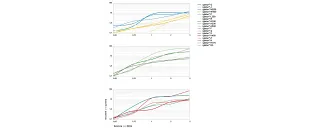
X = load [MPa]
Y = wear [μm/km]
Wear of iglidur plain bearings at low loads, shaft: Cf53, v = 0.1m/s
Importance of wear resistance
As the wear of components depends on many different factors, it is difficult to make general statements about the wear behaviour.
In a wide range of experiments and tests, measuring wear is the main focus. In testing, it has become clear what deviations are possible between different material pairings. At given loads and surface speeds, wear resistance between common material pairings can still vary slightly by a factor of 10.
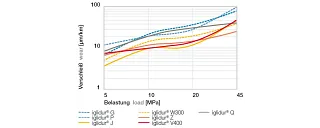
X = load [MPa]
Y = wear [μm/km]
Wear of iglidur® plain bearings at medium and high loads, shaft: Cf53, v = 0.1 m/s
Wear under load
Different loads greatly influence the bearing wear. Among the iglidur plain bearings, certain materials are optimised for low loads while others are suitable for use with high or extremely high loads. With its hardened, ground shafts, iglidur J can be described as the most wear-resistant bearing material for light loads. iglidur Q, in contrast, is the specialist for extremely high loads.
Table with a selection of iglidur materials and their wear limits
Within wide temperature ranges, the wear resistance of iglidur plain bearings changes only slightly. In the upper temperature range, however, the influence of the temperature increases, and the wear of the plain bearings intensifies disproportionately.
The table below compares the so-called wear limits.
Iglidur X is a special exception in this respect. The wear resistance of iglidur X plain bearings at first increases significantly and reaches its optimum at a temperature of +160°C. Then resistance decreases again, gradually.
Have you not found the required material? There is extensive data on all materials and data sheets in our shop.
| Material | Temp. [°C] |
|---|---|
| iglidur G | +120 |
| iglidur J | +70 |
| iglidur M250 | +80 |
| iglidur W300 | +120 |
| iglidur X | +210 |
| iglidur K | +90 |
| iglidur P | +100 |
| iglidur GLW | +100 |
| iglidur J260 | +80 |
| iglidur J3 | +70 |
| iglidur J350 | +140 |
| iglidur L250 | +120 |
| iglidur R | +70 |
| iglidur J200 | +70 |
| iglidur D | +70 |
| iglidur V400 | +130 |
| iglidur X6 | +210 |
| iglidur Z | +200 |
| iglidur® UW500 | +190 |
| iglidur H | +120 |
| iglidur H1 | +170 |
| iglidur H370 | +150 |
| iglidur H2 | +120 |
| iglidur A180 | +70 |
| iglidur A200 | +80 |
| iglidur A351 | +120 |
| iglidur A500 | +190 |
| iglidur A290 | +120 |
| iglidur T220 | +90 |
| iglidur F | +130 |
| iglidur H4 | +120 |
| iglidur Q | +80 |
| iglidur UW | +70 |
| iglidur B | +70 |
| iglidur C | +70 |
Further information to help understanding the best bearing for your application
Contact us
Contact details

Seán Ryan086 0329555Submit form
Opening hours
Office hours
Monday to Friday from 8 am - 8 pm.
Live chat:
24h