Change Language :
Types of bearings
A comparison guide to bearing types
If you are looking for suitable plain bearings, you can choose between different bearing types. These differ both in terms of their material and their mode of operation. However, they all have one thing in common: they work according to the same principle. The surface of moving components rubs or slides over the surface of the plain bearing. Various measures can be taken to minimise friction. To give you an overview, we summarise the structure and function of different plain bearing types here.
Bearings with lubrication groove
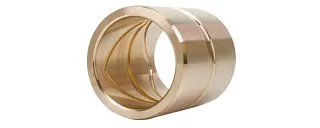
Plain bearings with lubrication grooves are made from a solid material. They are often made of steel, bronze or other metals. These bearings obtain their sliding properties from lubrication channels or lubrication grooves that are incorporated into the surface of the bearings. These channels allow the lubricating grease to be distributed more evenly throughout the entire bearing. However, this also means that the bearing must be permanently lubricated. Solid plain bearings can withstand high loads and are therefore often used in larger bearing points. However, due to the complex machining and solid material, they are also comparatively expensive.
Advantages
- High load capacity
- Protection against corrosion and dirt when lubrication is maintained
- Lubrication grooves ensure distribution of lubricant
Negatives
- Needs lubricating
- Can be expensive
- More prone to downtime and more likely to experience failures if not lubricated properly
Sintered bearings

Sinter bearings are named after the way they are manufactured. They usually consist of bronze powder that is compressed under high pressure and high temperatures. This process is called sintering. Due to the grain size of the powder, the bearing has pores after manufacture. The bearings are soaked in oil, which then settles in the pores. During use, the oil in the sintered bearing is heated by frictional heat, becomes more fluid and is thus released from the pores. The bearing point must therefore be lubricated. Sintered bearings are relatively cost-effective and, due to their mode of operation, are particularly suitable for bearing points with higher rotational speeds and less suitable for slow pivoting movements.
Advantages
- If the bearing point is correctly designed and constructed, the bearing is maintenance-free.
- During movement, the lubricant is released and "stored" again when the bearing is at a standstill.
- Robust and pressure-resistant.
Disadvantages
- Lower shock resilience
- Lower load capacity ( static)
- Less stability for heavy shock loads
- Requires additional lubrication
Fibre composite plain bearings
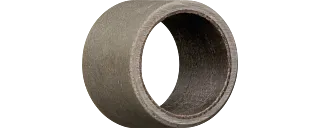
In fibre composite plain bearings, fibres made of glass, carbon, cotton or plastic are woven together, combined with synthetic resins and other additives, and compressed under high temperatures and pressure. This creates extremely resilient bearings whose strength can even match that of metal bearings, depending on the type of load. Different winding and weaving techniques can also be used to create different layers, which in turn have different specifications. A robust fabric often serves as the outer shell, while an inner layer optimised for sliding properties reduces friction in the bearing.
Advantages
- Suitable for high loads
- Self-lubricating and therefore low-maintenance
- Often more cost-effective than comparable metal bushings in large dimensions
- Corrosion-free
Negatives
- Due to frictional heat build up, these are less suitable for high RPM
- Not ideal for very high temperatures
- Might be more variation after press-fit
Metal composite bearings
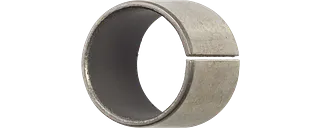
Metal composite bearings usually consist of a rolled metal sheet coated on the inside with a plastic layer optimised for sliding. PTFE or POM are often used as sliding materials. PTFE has such good sliding properties that bushings with a PTFE coating do not require additional lubrication with grease or oil. To ensure that the PTFE adheres to the sheet metal after rolling, a layer of porous bronze is often sintered onto it beforehand. Metal composite bearings are relatively cost-effective and suitable for various applications.
Advantages
- High static loads possible
- Comparatively good heat dissipation
- Low coefficients of friction (PTFE)
- No lubrication required for bearings with PTFE gliding layer
Negatives
- There is a higher risk of corrosion
- Requires constant lubrication
- Lower resistance to chemicals and water absorption.
Further useful information


Frequently asked questions
Depending on the application will depend on the bearing. It will also depend if you are tied to a specific bearing due to design restrictions. There are tools that can help you pick the right bearing, whether that be a plastic one or a metal one.
Yes many plastic ones are dry running. A lot of the metal versions require lubrication to prevent them from seizing.
In many applications they can. It will depend on factors such as loads, speeds, environmental factors but there are such a large range of plastic bearings that there is usually a plastic alternative to metal.
There are so many different types of bearings! Different materials, different forms, different geometries!
Traditionally there is Ball bearings, roller bearings, plain bearings and magnetic bearings.
Contact us
Contact details

Seán Ryan086 0329555Submit form
Opening hours
Office hours
Monday to Friday from 8 am - 8 pm.
Live chat:
24h