Change Language :
drylin® R - Technical information
Includes test methods and design tips
This page will hopefully help with vital information and data that you need for specifying the right parts for your application.
It also includes design tips for when using drylin R linear bearings.
Material data table
| General properties | Unit | iglidur J | iglidur X | iglidur J200 | Testing method |
|---|---|---|---|---|---|
| Density | g/cm³ | 1.49 | 1.44 | 1.72 | |
| Colour | yellow | black | dark grey | ||
| Max. moisture absorption at +23°C/50% room humidity | % weight | 0.3 | 0.1 | 0.2 | DIN 53495 |
| Max. moisture absorption | % weight | 1.3 | 0.5 | 0.7 | |
| Coefficient of sliding friction, dynamic against steel | µ | 0.06-0.18 | 0.09-0.27 | 0,11 - 0,22 | |
| pxv value, max. (dry) | MPa x m/s | 0.34 | 1.32 | 0.33 |
| Mechanical properties | |||||
|---|---|---|---|---|---|
| Flexural modulus | MPa | 2,400 | 8,100 | 2,800 | DIN 53457 |
| Flexural strength at 20°C | MPa | 73 | 170 | 58 | DIN 53452 |
| Compressive strength | MPa | 60 | 100 | 43 | |
| Maximum recommended surface pressure (20°C) | MPa | 35 | 150 | 23 | |
| Shore D hardness | 74 | 85 | 70 | DIN 53505 |
| Physical and thermal properties | |||||
|---|---|---|---|---|---|
| Max. long-term application temperature | °C | +90 | +250 | +90 | |
| Max. short-term application temperature | °C | +120 | +315 | +120 | |
| min. application temperature | °C | -50 | -100 | -50 | |
| Thermal conductivity | [W/m x K] | 0.25 | 0.6 | 0.24 | ASTM C 177 |
| Coefficient of thermal expansion (at 23°C) | [K-1 x 10⁻⁵] | 10 | 5 | 8 | DIN 53752 |
| Electrical properties | |||||
|---|---|---|---|---|---|
| Specific transitional resistance | Ωcm | > 1013 | < 105 | > 108 | DIN IEC 93 |
| Surface resistance | Ω | > 1012 | < 103 | > 108 | DIN 53482 |
| General properties | Unit | iglidur E7 | iglidur A180 | Testing method |
|---|---|---|---|---|
| Density | g/cm³ | 1.05 | 1.46 | |
| Colour | dark grey | white | ||
| Max. moisture absorption at +23°C/50% room humidity | % weight | 0.1 | 0.2 | DIN 53495 |
| Max. moisture absorption | % weight | 0.1 | 1.3 | |
| Coefficient of sliding friction, dynamic against steel | µ | 0.05-0.23 | ||
| pxv value, max. (dry) | MPa x m/s | 0.31 |
| Mechanical properties | ||||
|---|---|---|---|---|
| Flexural modulus | MPa | 1,477 | 2,300 | DIN 53457 |
| Flexural strength at 20°C | MPa | 22 | 88 | DIN 53452 |
| Compressive strength | MPa | 78 | ||
| Maximum recommended surface pressure (20°C) | MPa | 18 | 28 | |
| Shore D hardness | 61 | 76 | DIN 53505 |
| Physical and thermal properties | ||||
|---|---|---|---|---|
| Max. long-term application temperature | °C | +70 | +90 | |
| Max. short-term application temperature | °C | +90 | +110 | |
| min. application temperature | °C | -50 | -50 | |
| Thermal conductivity | [W/m x K] | 0.25 | ASTM C 177 | |
| Coefficient of thermal expansion (at 23°C) | [K-1 x 10⁻⁵] | 11 | DIN 53752 |
| Electrical properties | ||||
|---|---|---|---|---|
| Specific transitional resistance | Ωcm | < 1012 | DIN IEC 93 | |
| Surface resistance | Ω | > 109 | < 1011 | DIN 53482 |
drylin® R - Comparison of the permissible dynamic load with the same diameter

X = velocity v [m/s]
Y = F [N] Ø [mm]
A = unsupported shaft -steel/stainless steel
B = self-supporting shaft - hard anodised alum.
C = supported shaft -steel/stainless steel
D = supported shaft - hard anodised alum.
diagram. 01: drylin® R - Comparison of the permissible dynamic load with the same diameter
Why use drylin R bearings?
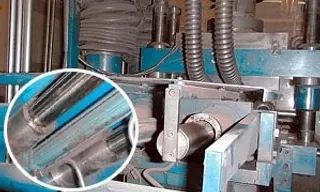
Dirt-resistant
The cylindrical standard bearings consist of a replaceable iglidur® J sliding film, which is clipped positively into an anodised aluminium adapter. The axial retention of the sliding film is realised via an annular groove.
The drylin® linear plain bearings are also available in solid plastic with the same dimensions. They are made entirely of the wear-resistant material iglidur® J and can offer technical advantages in addition to the significant price advantage. For example, applications in which machine parts are mainly made of stainless steel, such as food and filling technology, are predestined for the use of solid plastic bearings. A further weight saving is also easy to realise.
Both versions are designed for mounting in housing bore with tolerance H7. As with ball bushings, they are fastened using circlip according to DIN 471/472.
The narrow type of the cylindrical linear plain bearing, type 02, is pressed or glued into the H7 housing bore. Commercially available 2-component adhesives can be used for this purpose.
Dirt, dust, fibres
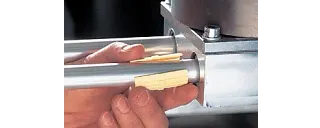
An important difference between all the linear bearings on offer is their compatibility with dirt. For most systems, the use of wipers or seals is recommended even with low levels of dust.
No other system offers such a high level of protection against dust, fluff and coarse dirt as drylin®. The absence of lubricants and the special design of the bearing surfaces with individual raceways and the interruptions between them have a particularly favourable effect in the event of contamination. Dirt, even if it is wet on the shaft, is wiped off the individual raceways and pushed back into the non-contact tracks. The crossbar of the running surfaces of the drylin®-bearing then glide on the track that has been wiped free of all dirt.
Split linear bearings
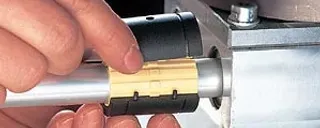
Applications at the limits of what is technically feasible or in extremely abrasive environments are characterised by the regular replacement of the bearing. In many cases, drylin® has been able to multiply the operating time. Nevertheless, it may be necessary to replace the bearing from time to time in such applications. drylin® linear plain bearings can contribute to considerable cost reductions in these cases, as only the bearing film needs to be replaced. This often saves costs of more than 90 %. There is also no need to remove the shafts.
The separable bearings are simply pulled out of the housing and opened. The sliding film is slotted and can be easily fitted to the shaft. Put the bearing halves back together, install - done. Assembly times can be reduced to a minimum with this programme of separable drylin® bearings.
Test method and design tip for drylin R
The stated values for "Fmax." refer to the performance of the iglidur® plain bearing foils made of high-performance plastics and cannot be used as the sole criterion for the calculation of an application. The max. The maximum load capacity of the overall bearing system depends on the installation position, housing shape, housing material, connection including the screws used and requires a separate check. For the complete design of your application, please use our online design software "drylin® Expert system".
igus® test method for determining the tolerance of drylin® linear plain bearings
In order to guarantee the function of a drylin® R linear plain bearing, it is necessary to use the bearing with a defined minimum interference (bearing clearance). The quality control of this part is carried out with a plug gauge test. For this purpose, a certain force is defined with which the plug gauge is loaded when the plain bearing is tested.
| Order number | Test force [N] | Øi test housing | min. bearing Øi (plug gauge free) | Max. bearing Øi (plug gauge hangs) |
|---|---|---|---|---|
| JUM-01/02-10 | 0.981 | 12,000 mm | 10,030 mm | 10,070 mm |
| JUM-01/02-12 | 1.373 | 14,000 mm | 12,030 mm | 12.070 mm |
| JUM-01/02-16 | 1.864 | 18,000 mm | 16,030 mm | 16,070 mm |
| JUM-01/02-20 | 2.649 | 23,000 mm | 20,030 mm | 20,070 mm |
| JUM-01/02-25 | 3.729 | 28,000 mm | 25,030 mm | 25,070 mm |
| JUM-01/02-30 | 4.807 | 34,000 mm | 30,040 mm | 30.09 mm |
| JUM-01/02-40 | 7.063 | 44,000 mm | 40,040 mm | 40.09 mm |
| JUM-01/02-50 | 9.810 | 55,000 mm | 50,050 mm | 50,100 mm |
| JUI-01-06 | 0.981 | 0.4684 inch | 0.3768 inch | 0.3776 inch |
| JUI-01-08 | 1.373 | 0.5934 inch | 0.5016 inch | 0.5024 inch |
| JUI-01-10 | 1.864 | 0.7184 inch | 0.6268 inch | 0.6276 inch |
| JUI-01-12 | 2.649 | 0.8747 inch | 0.7516 inch | 0.7524 inch |
| JUI-01-16 | 3.729 | 1.1247 inch | 1.0016 inch | 1.0024 inch |
| JUI-01-20 | 4.807 | 1.4058 inch | 1.2520 inch | 1.2531 inch |
| JUI-01-24 | 7.063 | 1.6558 inch | 1.5020 inch | 1.5031 inch |
| JUI-01-32 | 9.810 | 2.1870 inch | 2.0024 inch | 2.0039 inch |
| RJM-01-08 | 0.981 | 16,000 mm | 8.025 mm | 8.061 mm |
| RJM-01-10 | 0.981 | 19,000 mm | 10.025 mm | 10.061 mm |
| RJM-01-12 | 1.373 | 22,000 mm | 12.032 mm | 12.075 mm |
| RJM-01-16 | 1.864 | 26,000 mm | 16.032 mm | 16.075 mm |
| RJM-01-20 | 2.649 | 32,000 mm | 20,040 mm | 20.092 mm |
| RJM-01-25 | 3.729 | 40,000 mm | 25,040 mm | 25.092 mm |
| RJM-01-30 | 4.807 | 47,000 mm | 30,040 mm | 30.092 mm |
| RJM-01-40 | 7.063 | 62,000 mm | 40,050 mm | 40.112 mm |
| RJI-01-06 | 0.981 | 0.6250 inch | 0.3762 inch | 0.3776 inch |
| RJI-01-08 | 1.373 | 0.8750 inch | 0.5013 inch | 0.5030 inch |
| RJI-01-10 | 1.864 | 1.1250 inch | 0.6265 inch | 0.6282 inch |
| RJI-01-12 | 2.649 | 1,2500 inch | 0.7516 inch | 0.7536 inch |
| RJI-01-16 | 3.729 | 1.5625 inch | 1.0035 inch | 1.0056 inch |
| RJI-01-20 | 4.807 | 2.0000 inch | 1.2520 inch | 1.2544 inch |
| RJI-01-24 | 7.063 | 2.3750 inch | 1.5020 inch | 1.5044 inch |
| RJI-01-32 | 9.810 | 3.0000 inch | 2.0024 inch | 2.0053 inch |
| RJ260(U)M-02-12 | 1.373 | 19,000 mm | 12.032 mm | 12.084 mm |
| RJ260(U)M-02-16 | 1.864 | 24,000 mm | 16.032 mm | 16.084 mm |
| RJ260(U)M-02-20 | 2.649 | 28,000 mm | 20,040 mm | 20,100 mm |
| RJ260(U)M-02-25 | 3.729 | 35,000 mm | 25,040 mm | 25,100 mm |
| XUMO-01-10 | 0.981 | 12,000 mm | 9.98 mm | 10.02 mm |
| XUMO-01-12 | 1.373 | 14,000 mm | 12.02 mm | 12.06 mm |
| XUMO-01-16 | 1.864 | 18,000 mm | 16.02 mm | 16.06 mm |
| XUMO-01-20 | 2.649 | 23,000 mm | 20.03 mm | 20.07 mm |
| XUMO-01-25 | 3.729 | 28,000 mm | 24.97 mm | 25.01 mm |
| XUMO-01-30 | 4.807 | 34,000 mm | 29.96 mm | 30.01 mm |
| XUMO-01-40 | 7.063 | 44,000 mm | 40.00 mm | 40.05 mm |
Explanation:
The material iglidur® X has a higher stiffness than iglidur® J. As a result, the ratio of test force to LD diameter shifts - depending on the diameter - in comparison. The parts are designed so that the clearance under load between iglidur® X and iglidur® J bearings is as identical as possible. This can lead to increased displacement forces in the unloaded new condition on an h-tolerated shaft when using the iglidur® X plain bearing foils.
When using a plain bearing (e.g. JUM/RJM) in conjunction with an adapter/housing (e.g. RJUM, OJUM, RGA), the manufacturing tolerance of the housing bore (usually: H7) is added to the minimum clearance listed above. The sum of these two values then gives the maximum possible bearing tolerance. Plain bearings of the dimensional series "Japan-Std." (JUJ) are tested according to the same criteria as the JUM plain bearing.
The effective bearing clearance is also influenced by the shaft tolerance. The undersize of the shaft must be added if necessary.
Fmax. dynamic:
The maximum values result from the projected bearing area and 5 MPa surface pressure.
Fmax. static:
The maximum values result from the projected bearing area and 35 MPa surface pressure.
Contact us
Contact details

Seán Ryan086 0329555Submit form
Opening hours
Office hours
Monday to Friday from 8 am - 8 pm.
Live chat:
24h